Historical story · 2 min read
How a microfilm brought a 1563 catechism back into view
A book can disappear from view while copies of its pages survive. The story of Petrus Dathenus’s 1563 Dutch Heidelberg Catechism passes through an old reprint, photographs, and a microfilm. What returned to view included more than the familiar questions and answers.
Published
A Dutch translation from the first year
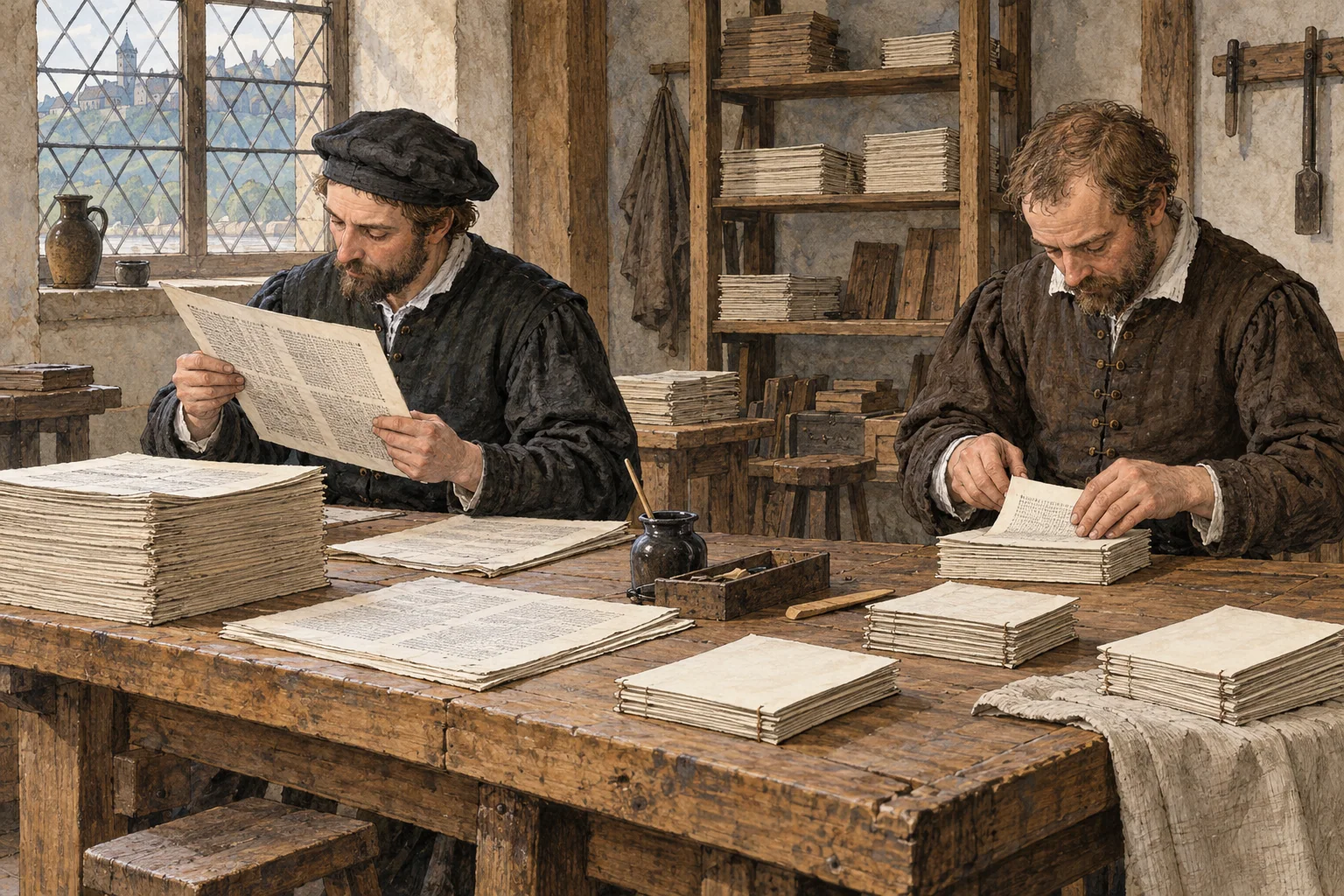
Petrus Dathenus’s Dutch translation appeared in 1563, the same year as the catechism’s first German editions. It brought the new teaching text to Dutch-speaking readers, together with material for worship and prayer.
In November 2024, the Protestant Theological University announced that Klaas-Willem de Jong and Wouter Kroese had found a microfilm preserving this early Dutch edition. The university made images available for further study.
A reprint had preserved only part of the volume
As the scholarly study explains, J. I. Doedes drew attention to the book through a nineteenth-century reprint. His reproduction left out the preface, marginal Bible references, and prayers. Readers could therefore encounter the catechism’s central text without seeing everything that had accompanied it.
The missing references and prayers help explain how the book was used. Readers could follow the biblical support for an answer and turn from learning doctrine to praying in church or at home.
Photographs, wartime loss, and a film in an archive
After the original volume was sold and taken to New York, photographs were made at W. G. Goeters’s request. His photographic material was lost during the Second World War. His son, J. F. G. Goeters, later obtained a microfilm of the photographs, which became part of his archive in Düsseldorf.
In their 2024 study, de Jong and Kroese reported that they had also located the original book in private hands, although it was inaccessible to them. The microfilm had a gap of its own: images of the book’s pages 14–15 were missing.
The film nevertheless made the surrounding material available for study again. Its survival allowed readers to recover much that the nineteenth-century reprint had left out.
The small print and the prayers
The recovered material included seven prayers: three for Sunday worship and four for household use. Alongside the biblical references in the margins, these offer a view of how the catechism was placed within church and daily life.
The arrangement brought instruction and devotion into the same volume. A family could move from learning an answer to praying together; in church, shared prayers gave the teaching a place within worship.
The university’s digital edition lets readers explore these page images and accompanying prayers. Continue with the history of the catechism’s early editions or the guide to its teaching on prayer.
Sources and further reading
These guides explain the text from a Reformed perspective. They are original editorial commentary, separate from the historic confession and its published translation.
- Protestant Theological University: Rediscovered 1563 catechism editionUniversity announcement, 20 November 2024, in Dutch.
- Klaas-Willem de Jong and Wouter Kroese: One of the First Dutch Translations (1563) of the Heidelberg CatechismChurch History and Religious Culture 104 (2024), pages 530–562. The qualifications about the original and film appear on page 550 and footnote 81.
- Digital edition of Dathenus’s 1563 catechismInstitutional access to the recovered page images and an introduction.
- The edition used on this reading websiteThis website’s modern source edition is distinct from the historical Dutch volume.