History · 2 min read
Who wrote the Heidelberg Catechism, and why?
The Heidelberg Catechism was prepared in the German Electoral Palatinate and first published in 1563. It gave churches and schools a common way to teach Christian faith, beginning with the believer’s comfort in belonging to Jesus Christ.
Published
A common voice for churches and schools
Frederick III commissioned the catechism for the Palatinate. Its purpose included instruction of the young, guidance for preaching, and a shared confession. The RCA’s historical account places it within that teaching programme.
That purpose helps explain its form. A question invites an answer that can be learned, repeated, and discussed. The resulting text can serve a classroom, a household conversation, or congregational teaching without requiring a different theological outline for each setting.
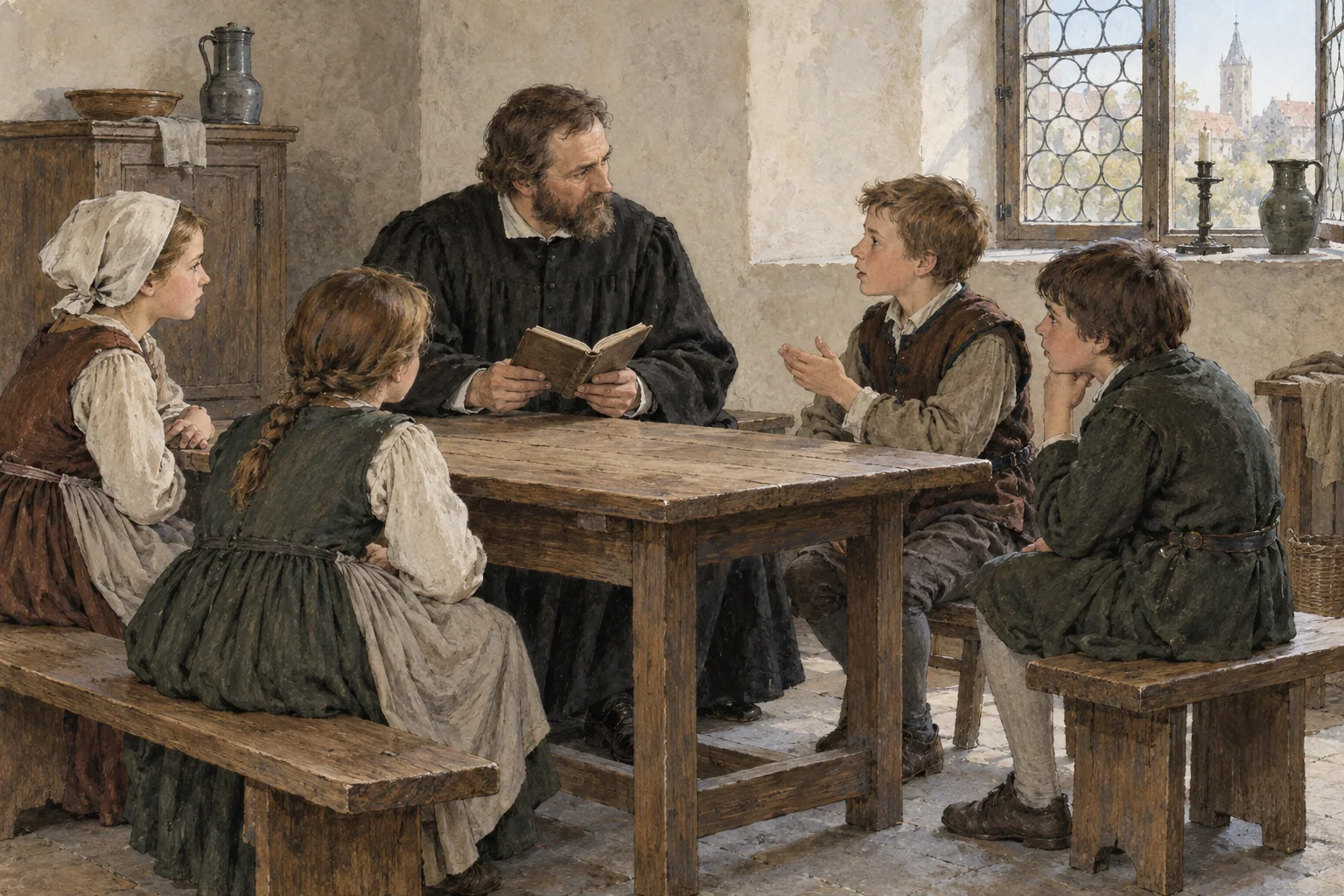
The opening question gives this teaching a personal focus. It asks about comfort in life and death, then follows that comfort through the saving work of Christ and the life of faith, gratitude and prayer.
Ursinus, Olevianus, and a drafting team
Zacharias Ursinus is generally recognised as the principal theological drafter. Caspar Olevianus also took part, although the extent of his contribution remains uncertain. Ministers, university theologians and church leaders worked on the text under Frederick III’s oversight.
The authorship discussion at Heidelberg-Catechism.com draws attention to Frederick’s preface, which credits the cooperation of the theological faculty and church leadership. The familiar pairing of Ursinus and Olevianus sits within that wider collaboration.
The text developed during 1563
The familiar catechism contains 129 questions, but the first edition had 128. Question 80 was added in the second edition and expanded in the third. Utrecht University’s account of its surviving early copies documents this development.
The division into 52 Lord’s Days belongs to its early use as a regular teaching text. The catechism was included in the Palatinate church order in 1563 and later received by the Synod of Dort. These milestones explain how a local teaching project gained a wider place in Reformed church life.
- 1563: First publication
A catechism for the Palatinate appears with 128 questions.
- 1563: Revised editions
Question 80 is added and expanded; the familiar text has 129 questions.
- 1619: Reception at Dort
The Synod of Dort approves the catechism.
The edition you are reading
This site follows the English text in the CRCA-published PDF. The About page identifies the translation and explains its presentation, including the capitalisation of divine pronouns.
The notes accompanying Question 80 describe later decisions by the Christian Reformed Church in North America and the Reformed Church in America concerning its language about the Roman Catholic Mass. They report those denominations’ decisions, rather than a decision by the CRCA.
Begin with Question 1, then follow Question 2 into the three-part structure. The history supplies context; the questions themselves show what the catechism was written to teach.
Sources and further reading
These guides explain the text from a Reformed perspective. They are original editorial commentary, separate from the historic confession and its published translation.
- RCA: History of the Heidelberg CatechismCommission, teaching purpose, publication, and use in Lord’s Days.
- Heidelberg-Catechism.com: AuthorshipDiscussion of the drafting team and the evidence concerning Ursinus and Olevianus, on a site sponsored by the Canadian Reformed Theological Seminary.
- Utrecht University: Heidelberg Catechism 1563Surviving early editions and the development from 128 to 129 questions.
- CRCA-published Heidelberg Catechism (PDF)The source edition for this site’s questions, answers, Scripture references, and edition notes.